Design
Summer News & Notes
In the Mix:
Dealer, Decorator, Designer
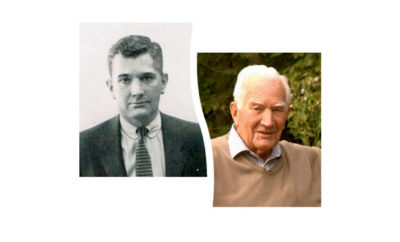
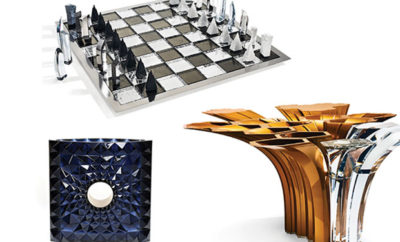
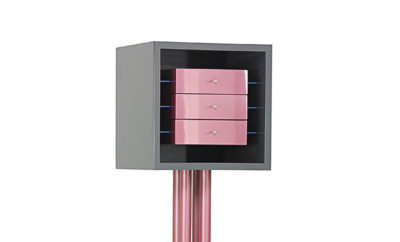
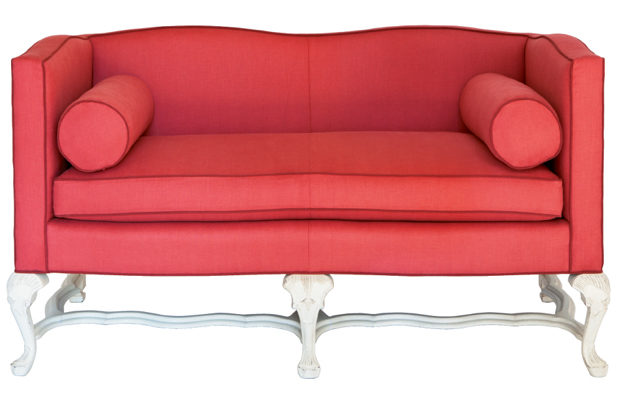
Evan Lobel has owned a gallery for fifteen years and sells some of the most venerable names in design. But in 2011, he became a designer in his own right when he released a collection of furniture called Night Star. His clean-lined commodes, tables, and upholstered pieces not only speak to Hollywood Regency style, but also explore the interaction of light and dark by juxtaposing materials. Radiant patterns pepper the collection, emblazoning the doors of a commode in hand-cut ebony, or the surface of a writing desk in pale, lacquered goatskin.
Lobel has a knack for wrestling unwieldy materials into complex arrangements of pattern—take for instance his resin console inset with lacquered slices of bamboo—so it’s not surprising that he cites designers like Edward Wormley, Ward Bennett, and Karl Springer (whose works he has sold for years) as pivotal inspirations. It follows that every detail is executed by hand, including the exquisite tufting on a series of sofas and chairs mounted on carved mahogany pedestals. “It’s all about wonderful materials,” Lobel says. “And, of course, the best craftsmanship possible.” lobelmodern.com
Michael Boyd debuted his new collection, PLANEfurniture, at Los Angeles’s Edward Cella Art and Architecture in April. Not surprisingly, planes and other geometries are central to the collection’s minimalistic, case-study feel. So are warm, sustainable materials (jute rope and plywood), striking primary colors (red), and “affordable” price points, all of which place the collection squarely in the wake of pioneering modernists such as Jean Prouvé, Donald Judd, and Gerrit Rietveld. Organized into four series named as sparely as the designs themselves—BLOCKseries, WEDGEseries, PLANKseries, and RODseries—the collection is at once pretentious and utilitarian, as comfortable in a gallery as it is on your patio. boyddesign.com
In Editions, her first collection of furniture, Liz O’Brien takes a stroll through decorative history, tweaking lines and techniques as she goes. Her Frances dining chair embodies Queen Anne style with sass, showing off cabriole legs and a plucky feminine shape. And her
Museum Walk: All That Glitters

Alessandro Mendini’s Proust’s Armchair, executed in mosaic, on view at the new Fondazione Bisazza near Vicenza, Italy.
Mosaics have a long and venerable history, dating back centuries before the Roman Empire. We have trekked to Venice, Istanbul, Ravenna, and Barcelona (among other places) to see mosaics of both distant and relatively recent history.
The new Fondazione Bisazza near Vicenza, Italy, will be the first museum and study center to celebrate mosaics in contemporary design, though its scope is much wider than mosaics alone. With the curator and writer Maria Cristina Didero as executive director and Bisazza’s chief of design Alessandro Mendini on board, the focus will be on contemporary design in the broadest sense. The museum opens on June 8 with the exhibition John Pawson: Plain Space in the temporary galleries.
The permanent installation will be devoted to a remarkable body of work that Bisazza has assembled over the years by asking an array of designers—selected for their wide-ranging imaginations—to re-imagine the application of mosaic tile. “We would like to enrich the collection by working with designers from around the world so that they will start discovering that mosaic tile is not only very beautiful but very flexible,” says Rossella Bisazza, who is the foundation’s vice president. Among the designers represented are Tord Boontje, Jaime Hayon, Alessandro Mendini, Fabio Novembre, Andrée Putman, Ettore Sottsass, Studio Job, Patricia Urquiola, and Marcel Wanders. fondazionebisazza.it
—Beth Dunlop
Margaret De Patta’s sculptural baubles elevated the language of jewelry. Half a century later, Space-Light-Structure, the first major retrospective of the work of this groundbreaking figure in the studio jewelry movement, will be at MAD in New York (June 5 through September 23—after being shown at the Oakland Museum of California, which organized it jointly with MAD). Fifty pieces of jewelry, in addition to ceramics and flatware, speak to De Patta’s bold, transformative style, like her fluid, space-bending pendants, which jettison conventional symmetries, and the way she illuminated stones from within using a technique she called “opticuts.” But De Patta did more than coin a radical new aesthetic. Blending Bauhaus ideals and constructivist style, she crafted cuffs, brooches, and rings that express a modernist’s vision.
madmuseum.org
—Damaris Colhoun
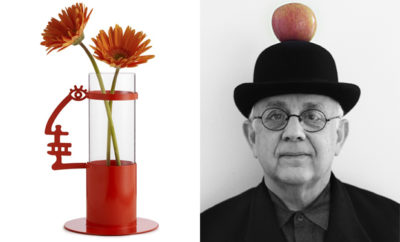
Century of the Child: Growing by Design, 1900–2000, at the Museum of Modern Art from July 29 to November 5, will explore projects related to children that are often underrepresented in design history, such as school architecture, playgrounds, nurseries, games, toys, and furniture. The exhibition will showcase the work of famous and unsung modern designers alike, including Richard Neagle (1922–2006). When he designed the Bamboozler clothes tree, suburban homes were mostly filled with unremarkable furniture in pseudo-historical styles. During the 1950s American toymakers, architects, designers, and even art museums, promised to develop a child’s creativity through specially designed objects, such as the Bamboozler, that reflected the belief of progressive educators and sociologists that learning could be synonymous with fun. moma.org
—Adriana Kertzer