Design
Summer News & Notes
In the Mix:
Dealer, Decorator, Designer
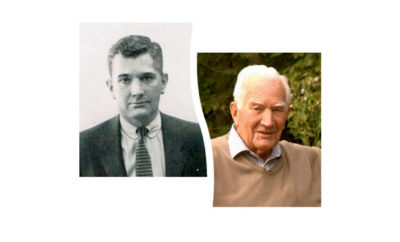
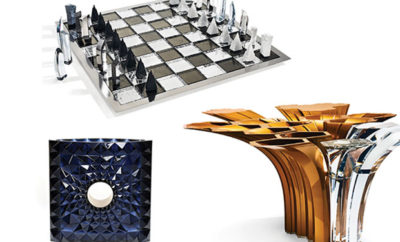
Evan Lobel has owned a gallery for fifteen years and sells some of the most venerable names in design. But in 2011, he became a designer in his own right when he released a collection of furniture called Night Star. His clean-lined commodes, tables, and upholstered pieces not only speak to Hollywood Regency style, but also explore the interaction of light and dark by juxtaposing materials. Radiant patterns pepper the collection, emblazoning the doors of a commode in hand-cut ebony, or the surface of a writing desk in pale, lacquered goatskin.
Lobel has a knack for wrestling unwieldy materials into complex arrangements of pattern—take for instance his resin console inset with lacquered slices of bamboo—so it’s not surprising that he cites designers like Edward Wormley, Ward Bennett, and Karl Springer (whose works he has sold for years) as pivotal inspirations. It follows that every detail is executed by hand, including the exquisite tufting on a series of sofas and chairs mounted on carved mahogany pedestals. “It’s all about wonderful materials,” Lobel says. “And, of course, the best craftsmanship possible.” lobelmodern.com
Michael Boyd debuted his new collection, PLANEfurniture, at Los Angeles’s Edward Cella Art and Architecture in April. Not surprisingly, planes and other geometries are central to the collection’s minimalistic, case-study feel. So are warm, sustainable materials (jute rope and plywood), striking primary colors (red), and “affordable” price points, all of which place the collection squarely in the wake of pioneering modernists such as Jean Prouvé, Donald Judd, and Gerrit Rietveld. Organized into four series named as sparely as the designs themselves—BLOCKseries, WEDGEseries, PLANKseries, and RODseries—the collection is at once pretentious and utilitarian, as comfortable in a gallery as it is on your patio. boyddesign.com
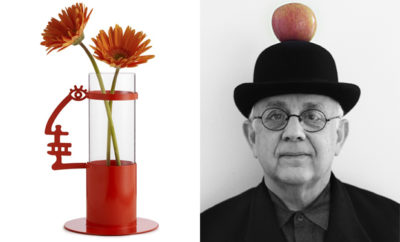
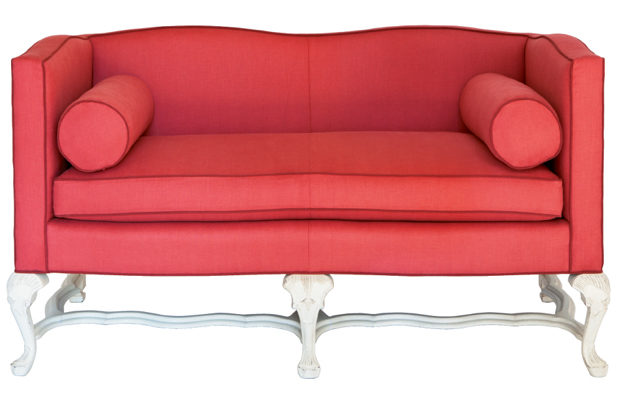
In Editions, her first collection of furniture, Liz O’Brien takes a stroll through decorative history, tweaking lines and techniques as she goes. Her Frances dining chair embodies Queen Anne style with sass, showing off cabriole legs and a plucky feminine shape. And her
Sitting it Out

Fritsch-Durisotti’s Bee lounger for TurriniBY.
Reading through TurriniBY’s website is like reading through a checklist of everything contemporary furniture should be—from a marketer’s perspective anyway. Designed in collaboration with “talented designers,” their “environmentally-friendly products” make them a “leader in the implementation of an Eco-Design approach.” So imagine our delight when we found ourselves genuinely liking some of TuriniBY’s designs. Collaboration with French architect Erwan Péron yielded two intriguing concepts. For the first, the Kristal table, Péron trisected an oak-veneered block with three planes of clear PMMA so that it floats above the ground. For the second, he interlocked two tapering horizontal planes—one of oak, the other of the composite Dacquacryl—to form the Alliance sideboard. Our favorite, though, is the Bee collection by the French design agency Fritsch-Durisotti. From the side, the graceful lines of the pieces—seating and tables—open like pods, revealing the internal honeycomb structure. turriniby.com
—Damaris Colhoun
Milan’s famed Salone Internationale del Mobile, staged every April, is the premier event for design lovers everywhere and it always offers a surfeit of riches—from the fairgrounds itself to all the events and openings that take place throughout the city. For those looking for outdoor furniture, there was an embarrassment of riches this year, with almost every major manufacturer offering new collections. And for discerning collectors, there was also an alluring selection from outside the mainstream.
It’s no longer news when fashion houses take on homewares. But this year Marni opted for a more original approach. Its exhibition included a collection of one hundred chairs made in Colombia by ex-prisoners—a project undertaken to help these people re-enter the community. The chairs, made of metal and multicolor PVC cords, are of a type common throughout Colombia, but Marni created new color variations and patterns, so each one is unique. The presentation will tour Marni stores around the globe and funds raised by their sale will go to a Milan charity for children of imprisoned mothers.
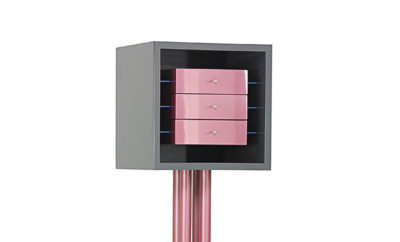
Young Slovenian designer Nika Zupanc, whose work is already bought by collectors (her pieces are listed on artnet.com) presented her idiosyncratic take on outdoor furniture with her Summertime collection at Spazio Rossana Orlandi, Milan’s fabled emporium of design. The lines of the pieces are simple, but her vision is far from ordinary since black is not usually a warm weather color choice. Tables and chairs have metallic pink frames. Chairs are upholstered in an outdoor fabric with a sharkskin-like finish, adorned with an embroidered anchor. The table has a toy-like winding mechanism that allows the top to flip up or over—one side is a mirror, the other a blackboard. The poetically pink Venetian glass pendant lights, made in collaboration with Vistosi, the Murano glassmaker, provide a softening allure.
—Arlene Hirst
”Modern is what deserves to become an antique,” Dino Gavina, one of the pioneers of Italian design, once claimed. And that status is what Sawaya and Moroni aimed for with Fei Fei, a high-density polyurethane chair designed by William Sawaya and made from five different molds—an ultra sophisticated manufacturing process. “It comes out as just one piece,” says Paolo Moroni, who explained that the chair has an interior steel structure to give it rigidity. On the first days of the fair, the Fei Fei attracted museum curators from Indianapolis and Montreal who purchased examples for their collections, betting on the chair’s future antique status.