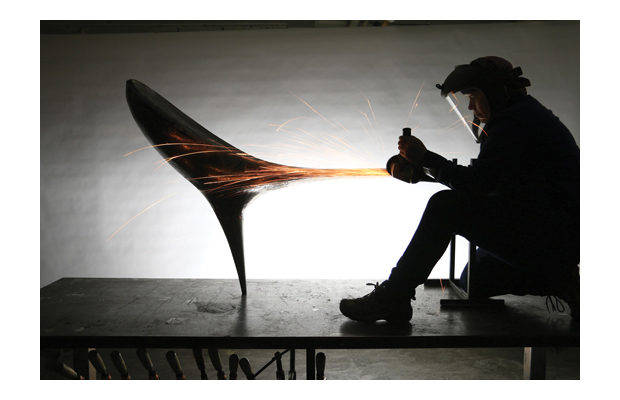
 Vivian Beer in her studio at work on Anchored Candy, 2014.
Feature
Pathmakers
Women in Art, Craft, and Design, Midcentury and Today
AN ICONIC PHOTO OF FIVE OF THE MOST FAMOUS DESIGNERS of the post-World War II era appeared in Playboy in July 1962; it featured George Nelson, Edward Wormley, Eero Saarinen, Harry Bertoia, Charles Eames, and Jens Risom near furniture of their own creation. The image speaks volumes about the ways in which modern design has been portrayed in popular culture and often even in museum exhibitions and history books: designers are all men, and design means furniture.
For Pathmakers: Women in Art, Craft, and Design, Midcentury and Today, an exhibition for the Museum of Arts and Design (MAD) in New York City, my co-curator Ezra Shales and I decided to investigate and celebrate the areas in which women played important, if unsung, roles during this period. Given MAD’s historic focus on craft, we looked particularly at the ways in which the resurgence of interest in craft after World War II opened doors for women to become professional artists, designers, and teachers.

Swedish design trio Front—from left, Charlotte von der Lancken, Anna Lindgren, and Sofia Lagerkvist—with their plumbing fixture designs for Axor. Photo by Alexander Schneider.
We ended up finding far more women than could be covered in a single exhibition. For the show we selected thirty-three who demonstrated the range of ways in which women contributed to modern design, including famous names such as Eva Zeisel, Ruth Asawa, and Sheila Hicks along with lesser-known ones, including Karen Karnes, Alice Kagawa Parrott, and Margaret Tafoya. (While Pathmakers focuses mainly on women in the United States, we did include a few women from Scandinavia, where we found a parallel situation.) The first half of the exhibition looks at the many ways in which women in this period contributed to visual culture. The second half considers artists and designers who are carrying on their legacy today.
Working in ceramics, textiles, and fine metals, women designers in the postwar period created objects for major corporations and elegant department stores. They collaborated with architects on modern interiors (and occasionally exteriors) for buildings such as the General Motors Technical Center (exterior tiles by Maija Grotell and textiles by Marianne Strengell), the Norton Simon Museum (exterior tiles by Edith Heath), the United Nations Headquarters (textiles by Dorothy Liebes), and the Ford Foundation (textiles by Sheila Hicks and tiles by Heath). They represented the United States at exhibitions and in diplomatic initiatives overseas.
Through these efforts, and through the works they created, women designers had lasting impact on postwar modernism, as well as on the generations to follow. The following profiles point up some of their important contributions. While Dorothy Liebes, Edith Heath, Marianne Strengell, and Vivianna Torun Bülow-Hübe are not well-known today, during the 1950s and 1960s they played key roles in interpreting modernism for the postwar world. Their innovative designs and enterprising spirits offer a forward-looking comparison to contemporary designers.
As a final thought, while our research shows that the field has expanded markedly in the past fifty years, we’d like to see women become even more prominent in certain areas of the design world—industrial design and architecture in particular.

Torun designed the Vivianna Bangle watch for Georg Jensen in 1969.
VIVIANNA TORUN BÜLOW-HÜBE
Jewelry maker Vivianna Torun Bülow-Hübe, or simply Torun as she was often known, stands out for her international appeal and the playful way she flaunted conventions. She didn’t use gems, preferring rock crystal, moonstone, and quartz; and these stones often hung down the back, instead of the front, of the wearer.
Torun spent the 1950s and 1960s in France, in Paris and in the southern town of Biot, moving in social circles that included jazz musicians and avant-garde artists such as Picasso. Her jewelry was worn by Billie Holiday, Ingrid Bergman, and Brigitte Bardot. Later in life she followed the spiritual movement Subud, and moved first to Germany and later to Jakarta to be closer to the community. Throughout this time she designed for the Danish silver firm Georg Jensen, including perhaps her most famous piece, the Vivianna Bangle watch. Of the watch, she wrote: “I wanted to free people from the slavery of time…. The watch is open ended to symbolize that time should not bind us, and the dial like a mirror reminds us that life is now.”